Table of contents
Remote patient monitoring, using connected devices to track a patient's health between visits, was already an established model of care before COVID-19, but the pandemic and expanded reimbursement substantially accelerated its adoption for chronic-disease management. Medicare spending on it grew more than twentyfold, the patient count is approaching a million, and the market is worth tens of billions. Here is remote patient monitoring by the numbers, updated for 2026.
The headline numbers
Remote monitoring in four figures.
Market size
A market doubling this decade.
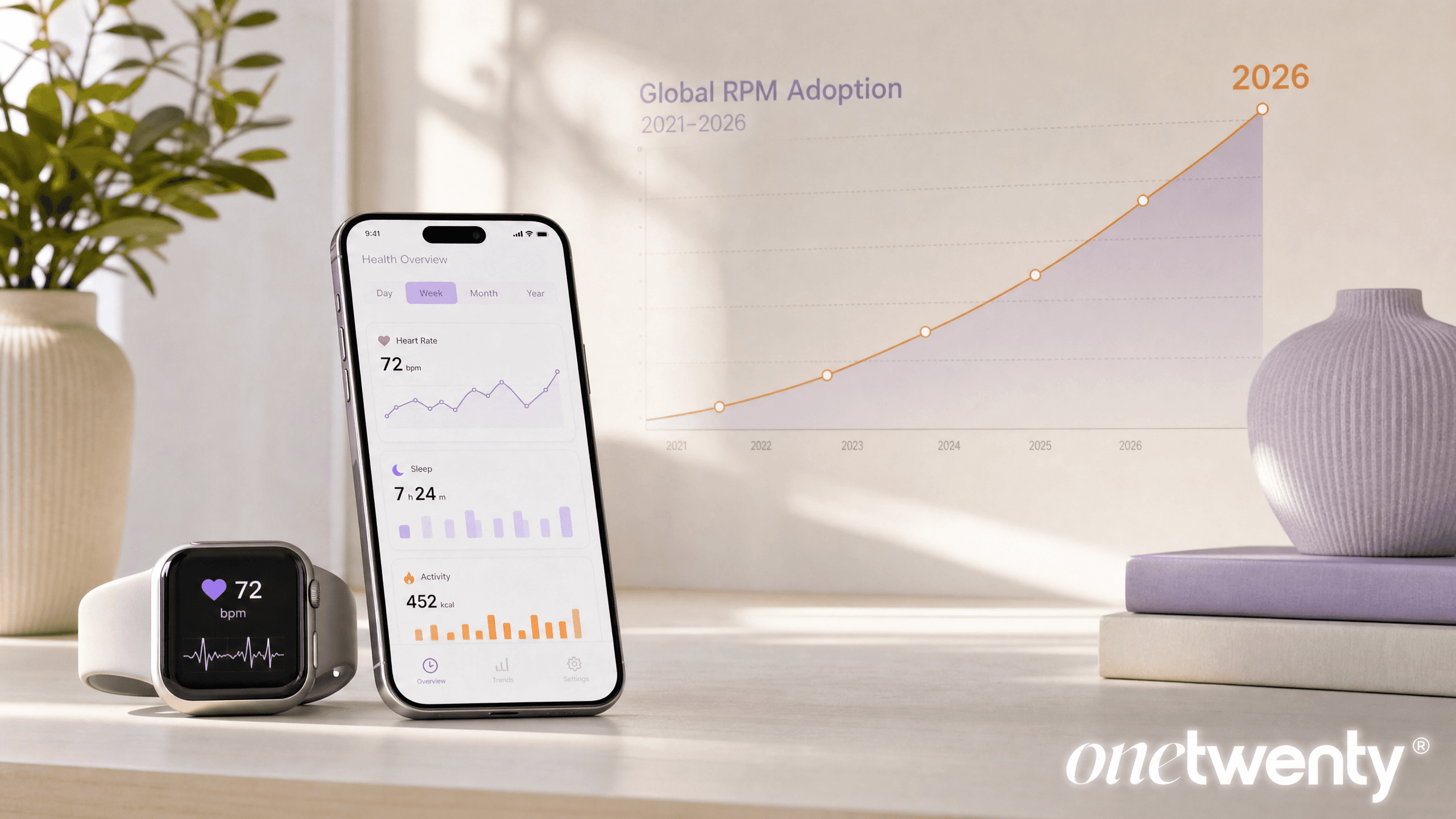
The US remote patient monitoring market was worth about $14.2 billion in 2024 and $16.1 billion in 2025, and is projected to roughly double to $29.1 billion by 2030, a steady 12.8% compound annual growth rate, according to MarketsandMarkets. The aging population, the rising chronic-disease burden, and a shift toward care delivered at home are the main drivers.
US remote patient monitoring market, 12.8% CAGR. Years between anchors are the projected trajectory. Source: MarketsandMarkets.
A caveat on the numbers
Estimates vary, a lot.
Market-size figures for RPM differ wildly between research firms, mostly because each defines the market differently, some count only devices, others add software and services. Treat any single number with caution. Here is the spread.
| Research firm | Scope | Base | Forecast | CAGR |
|---|---|---|---|---|
| MarketsandMarkets | US | $14.2B (2024) | $29.1B (2030) | 12.8% |
| MarketsandMarkets | Global | $27.7B (2024) | $56.9B (2030) | 12.7% |
| Wissen Research | Global | $40B (2023) | $88B (2030) | ~12% |
| Roots Analysis | Global | $9.4B (2025) | $88B (2035) | 25% |
| Business Research Co. | Global | Not stated | $111.9B (2030) | 15.1% |
Selected published RPM market estimates. The wide range reflects different definitions of what counts as the RPM market. Sources: MarketsandMarkets, Wissen Research, Roots Analysis, The Business Research Company.
The catalyst
Reimbursement and the pandemic drove the surge.
The clearest signal of RPM's rise is in the Medicare data. After Medicare expanded reimbursement beginning in 2019, and as telehealth use surged during the COVID-19 pandemic, annual spending jumped from about $15 million in 2019 to $311 million in 2022, and kept climbing to more than $536 million in 2024, per the HHS Office of Inspector General and its 2025 billing snapshot.
Total Medicare spending on remote patient monitoring. Source: HHS Office of Inspector General (2024 report and 2025 billing snapshot).
The patient count
From 55,000 to nearly a million.
The number of Medicare enrollees receiving RPM rose roughly tenfold between 2019 and 2022, from 55,000 to 570,000, then nearly doubled again to about 970,000 by 2024. RPM is now a mainstream Medicare benefit.
Medicare enrollees receiving remote patient monitoring. Source: HHS Office of Inspector General.
| Year | Medicare enrollees | Medicare payments |
|---|---|---|
| 2019 | 55,000 | $15M |
| 2022 | 570,000 | $311M |
| 2024 | ~970,000 | $536M |
Medicare RPM growth at a glance. Source: HHS OIG (2024 report and 2025 billing snapshot).
When growth outruns the rules
The boom got ahead of its guardrails.
That speed drew scrutiny. A federal review found that about 43% of enrollees who received RPM did not get all three of its required components, education and setup, a connected device, and monthly treatment management, raising questions about whether the monitoring was always doing what it was billed for.
Share of Medicare RPM enrollees, 2019 to 2022, missing each required service component. Source: HHS Office of Inspector General.
As use exploded, a federal review called Medicare's monitoring rules "generous and extraordinarily broad."
Why it keeps growing
A vast pool of chronic disease.
RPM exists because chronic disease is everywhere and occasional office visits leave long blind spots between appointments. An estimated 129 million Americans have at least one major chronic disease, and the conditions cluster: about 42% of adults have two or more, per the CDC.
Share of US adults by number of major chronic conditions. Source: CDC, Preventing Chronic Disease (2024).
What it monitors
The conditions RPM was built for.
The biggest RPM use cases are exactly the high-prevalence conditions that need frequent, numbers-driven management. Hypertension, diabetes, and heart failure are among the most common clinical applications. Continuous glucose monitors and connected blood-pressure cuffs are the consumer-facing tip of this iceberg.
Approximate US adult prevalence. Sources: CDC and the American Heart Association (hypertension ~120M); CDC National Diabetes Statistics Report (40.1M); Heart Failure Society of America (~6.7M).
The demographic tailwind
And the population keeps aging.
The single biggest structural driver is age. The US population aged 65 and older is projected to grow from about 58 million in 2022 to 82 million by 2050, a 47% increase. Older adults carry the most chronic disease and are the heaviest users of remote monitoring.
US population aged 65 and older. Source: Population Reference Bureau.
The economics
Why providers adopted it so fast.
RPM is reimbursed through a small set of Medicare billing codes that, combined, pay roughly $100 per patient per month. For a practice managing hundreds of patients, that adds up quickly, which is much of why adoption moved so fast.
| Code | What it covers |
|---|---|
| 99453 | One-time device setup and patient education |
| 99454 | Device supply and daily readings (16-day minimum per month) |
| 99457 | First 20 minutes of monthly treatment management |
| 99458 | Each additional 20 minutes of management |
Main Medicare RPM billing codes. Source: CMS Physician Fee Schedule. Exact amounts vary by year and locality.
Where it goes next
From sick care to continuous care.
The trajectory is set by a simple mismatch: a large, aging population with stacked chronic conditions, managed by a system built around occasional visits. Remote monitoring fills the gaps, and the spending, patient counts, and market size all point the same direction. Evidence supports RPM for several chronic conditions, including hypertension, diabetes, and heart failure, though effectiveness varies by condition, implementation, and patient engagement. Increasingly, the policy conversation is shifting toward how best to reimburse high-value programs, likely tying payment to outcomes rather than to the act of collecting data.
Medicare RPM spending grew more than twentyfold in three years.
Sources: HHS Office of Inspector General, Additional Oversight of Remote Patient Monitoring in Medicare Is Needed (2024) and its 2025 billing data snapshot; MarketsandMarkets US RPM market report; CDC, Preventing Chronic Disease (2024); CDC National Diabetes Statistics Report; the American Heart Association and Heart Failure Society of America; the US Centers for Medicare and Medicaid Services; and the Population Reference Bureau. Figures are rounded and current as of 2026. Market-size estimates vary widely by source and definition.
Fact Checked
Dr. Mohammed A. Fouda, MD
Dr. Fouda is a Neurosurgery research scholar. His work focus primarily on Brain tumor behavior and quality of life of cancer patients as well as biomedical engineering and medical device innovation.

How OneTwenty Works
Not your average
Checkup.
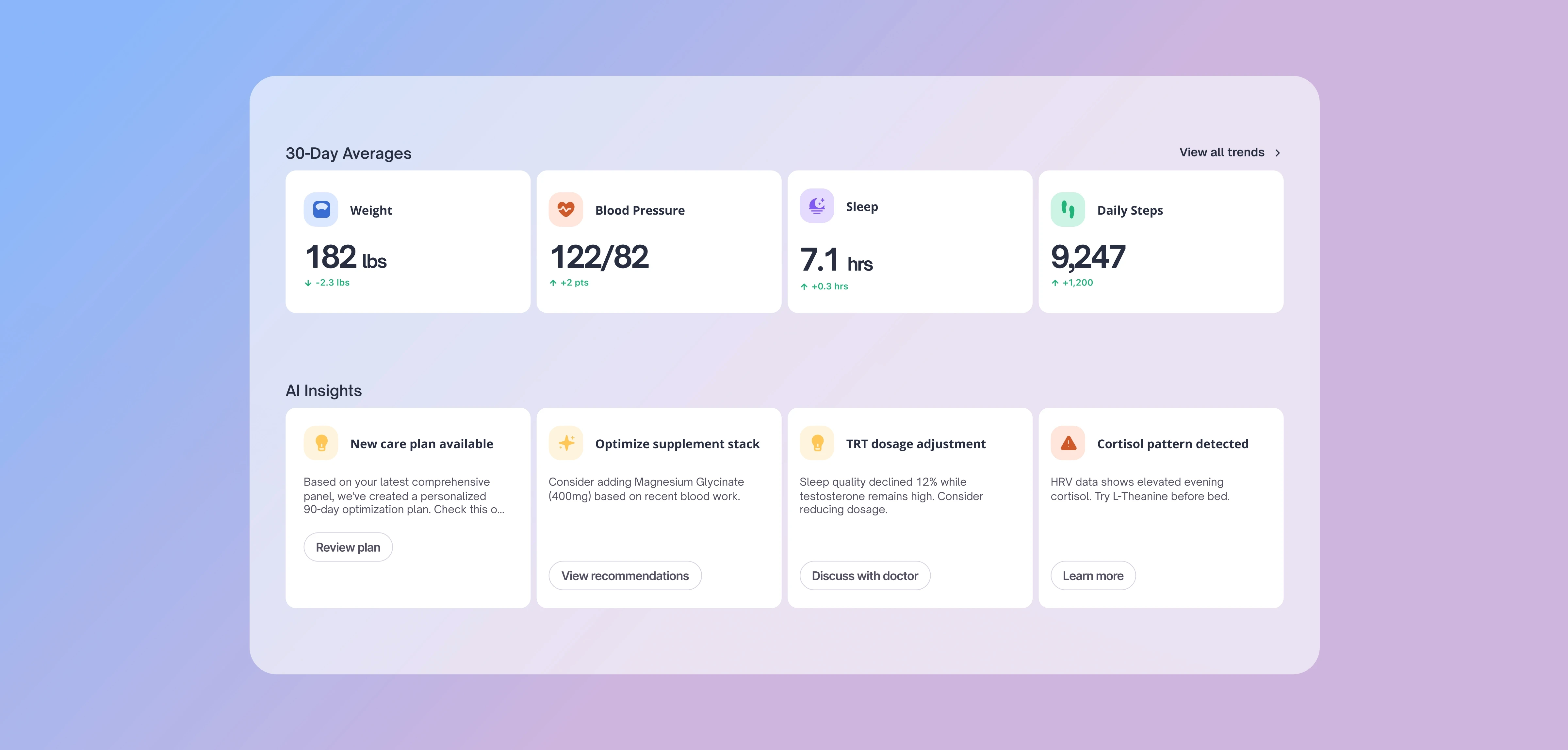
Every life stage brings new biological demands. Tracking the right metrics at the right time helps you adapt, optimize performance, and extend both lifespan and healthspan.
Your Annual Physical
Manual Data Processing
Guesswork Trend Detection
Once-a-year physical
Reactive, tested when sick
No data between visits
Once a year testing
Delayed Results
One-size dosing, set and forget
Real-Time Trend Insights
Daily smart-device data
Automated Data Sync
Quarterly Biomarker Tests
Optimal, personalized targets
Plain-language AI insights
Medications titrated to your data
Built to extend healthspan

Frequently Asked Questions
Clarity before
you commit
Answers on setup, scale, and support to remove blockers.